What Four Weeks in Baghdad Taught Me About Pressure and Leadership
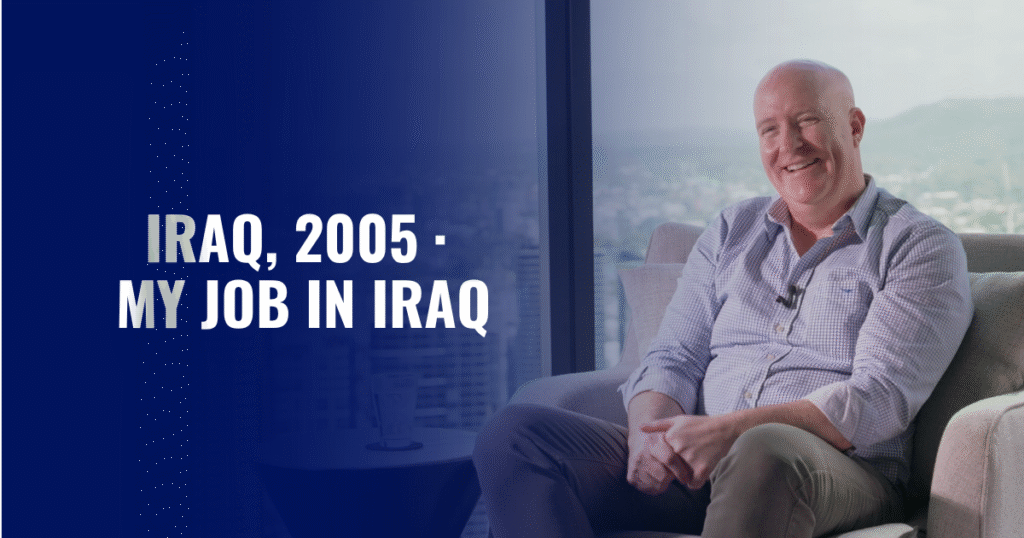
In 2005, I deployed to Iraq as part of Australia’s contribution to the conflict. Iraq was already a very serious environment by that stage. There were roadside bombs, rockets and mortars being fired into bases, and people were being killed and wounded regularly.
My original role was in Basra, working in a small Australian cell on the British Divisional Headquarters. I still remember arriving at night, being picked up by the Australians and taken straight to the armoury, where we were told to hand in our weapons. I remember thinking, What? Hang on. We’ve just arrived in Iraq and you want our weapons?
There was a perfectly sensible reason. The British had assessed that inside the base, the greater threat was somebody accidentally shooting someone. We only drew our weapons when we left the base. It was an early reminder that the risks you expect aren’t always the risks you actually face.
Not long after that, things changed again. The role I’d been sent to Basra to do became less important and our little cell effectively became redundant. At the same time, there was a critical liaison role that needed filling with an American Brigade Combat Team operating in the heart of Baghdad.
So I was told I was going to Baghdad for four weeks.
Four Weeks in Baghdad
Those four weeks gave me a very clear appreciation for how serious the situation was. In that period alone, the American brigade I was working with had 13 people killed in action, 26 wounded in action and one missing in action.
The missing soldier particularly stayed with me. When somebody is killed or wounded, as terrible as it is, there is something tangible to deal with. When somebody is missing, there’s no closure. I remember the anxiety and patrol after patrol going back out into Baghdad, trying to find him.
At the same time, there was a major effort underway to find Australian civilian Douglas Wood, who had been kidnapped. The story of how he was eventually found was relayed to me afterwards. An Iraqi Army unit was conducting routine house-to-house searches when a young lieutenant noticed a rolled-up rug against a wall. He initially left the room, then thought the rug looked a bit lumpy, went back and kicked it.
The rug moved.
Douglas Wood had been tied up and wrapped inside it.
After all the resources involved in trying to locate him, he was found because somebody on the ground noticed that something didn’t look right.
“I’m Just Looking for Holes”
I also had a couple of near-death experiences in Iraq, although strangely I didn’t necessarily realise how much danger I was in until afterwards.
On one occasion, I was flying across Baghdad in a helicopter when it started jarring fairly violently from side to side. I was just a passenger in the back and had no idea what was happening.
When we landed, I noticed one of the crew looking over the helicopter.
I asked him what he was doing.
“I’m just looking for holes.”
We’d been getting shot at from the ground.
Another time, I was outside the American PX when rockets exploded above us. It happened so quickly that they’d already gone off before I properly registered what was happening. I remember thinking it would have been a pretty ordinary letter for my family to receive: Your son was killed while shopping in Baghdad.
The next day, the Force Protection Officer told me I’d been very lucky. One of the rockets hadn’t functioned properly. Instead of fragmenting and throwing shrapnel around the area, it had effectively peeled open and fallen to the ground.
As an artillery officer, I knew that wasn’t how it was supposed to work.
Had it functioned correctly, I don’t know what would have happened.
Sometimes you’re simply lucky.
Keeping It in Perspective
Whenever I talk about Iraq, I think it’s important to put my own experience into perspective. I wasn’t a door kicker. I jokingly describe myself as a “FOBbit” because my job was predominantly inside the Forward Operating Bases (FOB).
There was danger, particularly when moving between bases, but it was nothing like what the people going outside the wire every day were experiencing.
I think that distinction matters. You don’t need to exaggerate your experience to make it valuable. Leadership requires you to deal in reality, and that includes being realistic about yourself.
There were people in Iraq who experienced things far beyond anything I did, and I have enormous respect for that.
What Does Any of This Have to Do With Running a Business?
Running a business in Australia is obviously nothing like operating in Baghdad, and I’m careful about making those comparisons. But one lesson from the military has stayed with me throughout my business career: you have to deal with the situation that actually exists, not the one you expected.
I went to Iraq with a job. I arrived in Basra expecting to do that job. Circumstances changed, the role became less important and suddenly I was being sent to Baghdad to do something else.
Business owners face a much lower-stakes version of that all the time. A key staff member leaves. A major client disappears. The market changes. Something you thought would work doesn’t. An unexpected opportunity appears.
A plan gives you direction, but leadership requires judgement. You need to recognise when the facts have changed, make a decision based on the situation in front of you and get your people moving in the right direction.
Your responsibility as the leader isn’t to prove that your original plan was right.
It’s to lead the organisation where it needs to go.
Watch the full story on YouTube: https://youtu.be/IwkEFMs3HkQ